




Why Do Malas Have 108 Beads?
No single reason explains it. The most common Buddhist answer is that people are said to carry 108 afflictions, and a mala gives one bead to each. Other reckonings exist, and the number also carries weight in Hindu and Jain traditions. The sources we read do not settle which explanation came first.
The usual answer: 108 afflictions
The Sanskrit word is klesha. English writers translate it as affliction, delusion or defilement. It covers the states of mind that keep a person unsettled, greed and envy among them.
Clark Strand, writing in Tricycle, puts it simply: a Buddhist mala typically has 108 beads, one for each of the delusions. His essay is titled “Worry Beads,” which is a fair plain-English version of the idea.
How the number is worked out
The figure comes from multiplication. Strand gives one version:
- Six: the kinds of delusion, arising through the six senses. Buddhist lists count the mind as the sixth.
- Three: each can be felt as past, present or future, which makes eighteen.
- Two: the two conditions of the heart.
- Three: the three sentiments of liking, disliking and indifference.
Six times three times two times three is 108. Strand adds that there are other ways of reaching the number, and there are. Different lists swap the factors and arrive at the same total. We cannot say which came first, the number or the sums.
Other readings of the number
The afflictions are the most familiar explanation and not the only one. The encyclopedia entry on the japamala, which draws on scholars of Buddhist material culture, records several more.
In one reckoning, 108 is the number of possible dharmas, or phenomena. In East Asian Buddhism it can also stand for 108 meditations, or for the 108 deities of the Vajradhatu Mandala. The number also holds religious significance in a number of Hindu and Jain traditions, so it is not a Buddhist number alone.
These readings sit side by side. A person holding a mala does not have to choose one.
Where the mala began
Nobody is certain. The oldest Buddhist literature, the Agamas and the Pali Nikayas, does not mention a mala. That leaves it unclear whether counting on beads began among Buddhists, Brahmins, Jains or another religious community in India.
The first written reference to using a mala for reciting mantras comes from the Mu Huanzi Jing, the “Soapberry Seed Scripture,” a Mahayana text in the Chinese Buddhist canon. In it the Buddha tells a king to make a mala from soapberry seeds.
A popular legend retold in Tricycle has a similar shape. King Vaidunya asks the Buddha for a simple practice to ease his people’s suffering during disease and famine. The Buddha tells him to make a circular string of 108 bodhi seeds and to count the Three Refuges on it. The seed changes with the telling. Strand’s point is that in this story the beads were not meant for monks.
How the count works in the hand
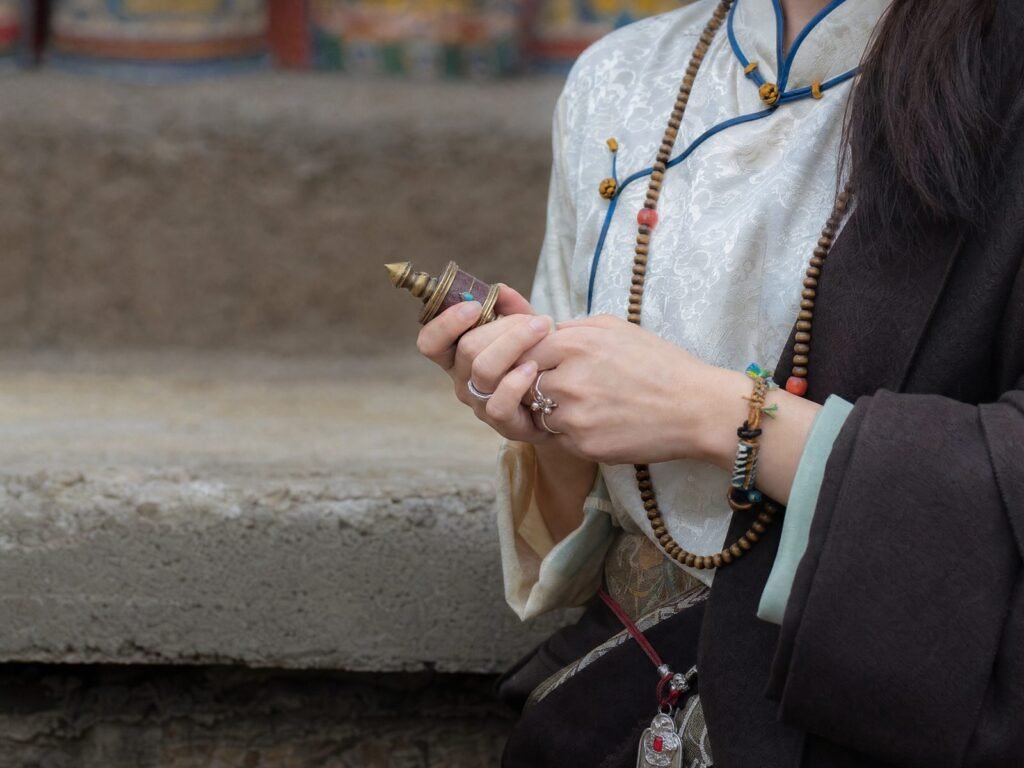
A mala is a counting tool first. Each bead marks one recitation of a mantra, a prayer or another sacred phrase.
In Tibetan practice there is a twist: a full round is recorded as 100, not 108. Michael Lobsang Tenpa, writing for Jamyang London Buddhist Centre, explains that the extra beads go uncounted, eight on a plain mala and eleven on one with dividers. They are an attempt to make up for mistakes made during recitation. Ten full rounds go down as 1,000.
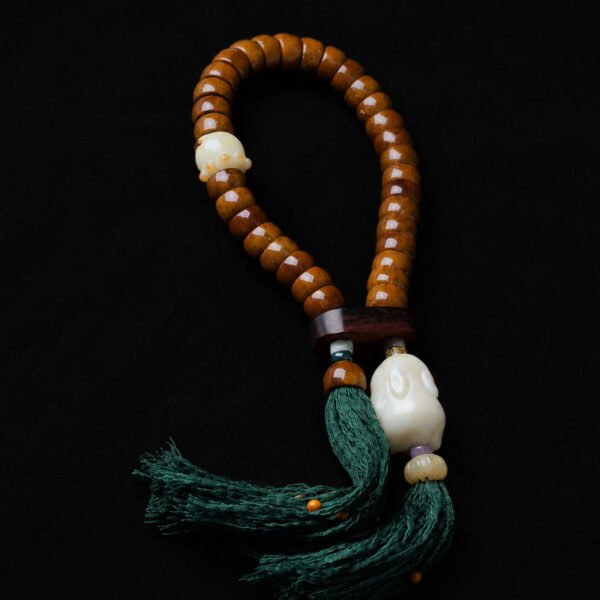
Many malas also carry a 109th bead, called the guru bead or mother bead. It is not counted. In some Buddhist traditions it represents the Buddha, Amitabha or Avalokitesvara. Some strands add three marker beads, which split the string into four sections of 27 so the person counting can tell how far around they are.
Why some malas have fewer
Shorter malas are made too, and their counts are often factors of 108: 54, 27 or 18. A smaller mala may be worn on the wrist, or used to keep count of prostrations.
Some of those numbers carry meanings of their own. The figure 54, whether in a 54-bead mala or the first half of a full one, is often read in East Asian Buddhism as the first 54 stages of the bodhisattva path.
Malas in our shop
The Star Moon Bodhi 108 Mala keeps the full count: 108 star moon bodhi seeds from Hainan, with a gold-tone guru bead and one banded agate bead. It wraps the wrist three or four times, or wears as a long necklace.
The Jade Maitreya Sandalwood Necklace is a long strand of small sandalwood beads ending in a Hetian jade Maitreya pendant. The Golden Rice Bowl Hand Mala is the short form, a loop of zijinshu seed beads with a guru bead, made to hold in the palm.
What a mala is said to do for the person holding it is a belief, not a promise, and we pass it on as one.
Common questions
Does a mala have to have 108 beads?
No. Shorter malas of 54, 27 or 18 beads are made too, and they may be worn on the wrist or used to count prostrations.
Is the guru bead one of the 108?
Usually not. It is a separate 109th bead and it is not counted.
Why is a Tibetan mala counted as 100?
A full round is recorded as 100 repetitions. The uncounted beads are there to make up for mistakes during recitation.
Is 108 only a Buddhist number?
No. It also has religious significance in a number of Hindu and Jain traditions, and malas are used across several Indian religions.